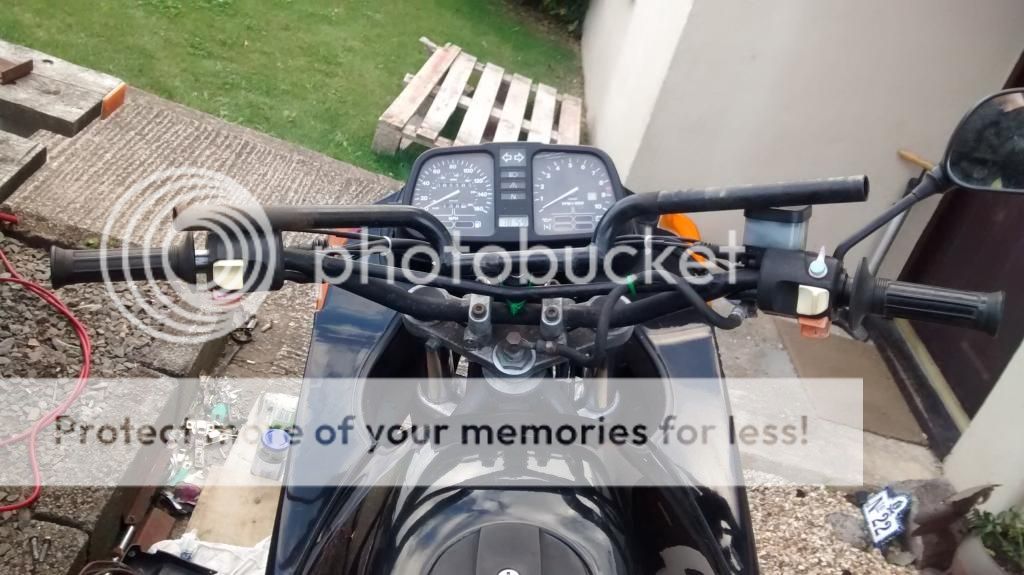
Seeing as you've dropped the forks through the yokes, you've effectively raised the front end. It might just be the angle of the pictures, but it now looks decidedly 'arse down'... What you've done is make a chopper - means that at slow speed the front wheel will try to 'flop' over one side or the other with even the tiniest amount of lean and it'll be heavier. :falldown:
If the tops of the forks were 3/4" proud of the yokes before (excluding the plastic caps if you have them, just to the top of the metal tube) it wouldn't surprise me if you have a short rear shock and the forks were pulled through to make the geometry 'closer', afaik the stock setting is flush... What length is the rear shock with the bike on the centrestand?
On my 75 (identical frame geometry) the oem rear shock died quite well so I got an aftermarket off ebay, which turned out to be a short one - I dropped the front nearly an inch to try and compensate and still had floppy yet heavy steering with little low speed precision. Since then I've done a few suspension related things:
Dropped the forks through as much as possible to raise the front.
Put rubber bushes in the tops of the forks to add some preload and get my sag a bit better.
Made a mount adaptor to lift the back end as high as it would go without the UJ in the shaft binding - I did this by supporting the shaft with a small jack (with no shock fitted) and kept lowering it until I could feel the UJ, then put it up a little and made the adaptor to suit. This adaptor is a 'prototype' for testing.....
After doing all that, it feels much lighter to steer at low speed and this is where I've got to - you should be able to see how much the top shock mount has moved, originally the top bolt was behind the end of the side panel:

I also have slightly wider handlebars too (originals are sat on top for comparison):